
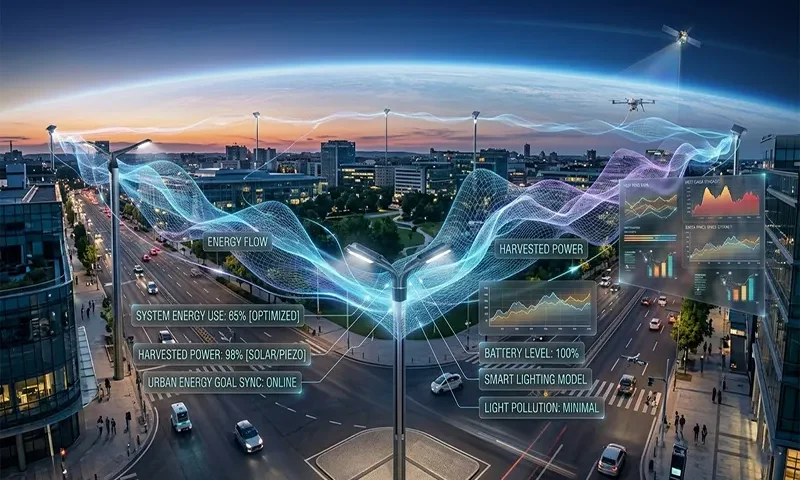
As global cities strive to meet 2026 carbon neutrality targets, street lighting has emerged as a primary lever for energy reduction. Traditionally representing up to 40% of a municipality’s total electricity expenditure, lighting infrastructure is being reimagined. The transition from static LED schedules to Adaptive AI Street Lighting allows the urban grid to function as a responsive “neural network.” By utilizing edge-based AI and real-time sensor fusion, cities can reduce energy consumption by an additional 40–60% beyond standard LED retrofits while simultaneously enhancing public safety and biodiversity.
The Luminous Cost of Urbanization
For over a century, street lighting followed a binary logic: it was either on or off. This static approach resulted in a massive “luminous waste,” where entire boulevards were illuminated at 100% capacity in the early hours of the morning despite zero pedestrian or vehicular traffic.
The “Dimming Dilemma” has long haunted urban planners—how to reduce the massive energy footprint without compromising public safety or increasing crime. In 2026, the answer lies in intelligence rather than simple curtailment. Adaptive AI systems allow cities to achieve aggressive energy goals without plunging neighborhoods into darkness, creating a “City that Breathes” in sync with its inhabitants.
The Architecture of Adaptive Intelligence
An adaptive lighting system is a complex ecosystem of hardware and software working in a low-latency loop.
- The Sensor Mesh: Modern luminaires are equipped with PIR (Passive Infrared) sensors for motion detection, acoustic sensors for sound-pattern recognition, and localized computer vision for traffic flow analysis.
- Communication Protocols: These poles communicate via mesh networks such as Wi-SUN or LoRaWAN, ensuring that if one pole detects a pedestrian, it can “pre-light” the next three poles in the path.
- The AI Controller: At the heart of the system is an edge-compute module that processes environmental data. Rather than sending raw video or audio to the cloud, the AI identifies “events” (e.g., a cyclist approaching at $25\ km/h$) and adjusts the power output accordingly.
Core Efficiency Strategies: Precision Illumination
The primary technical goal is to maximize Luminous Efficacy ($\eta$), which is the ratio of luminous flux ($\Phi$) to the power ($P$) consumed:
$$\eta = \frac{\Phi}{P}$$
Adaptive AI optimizes this by manipulating $P$ in real-time based on three strategies:
- Dynamic Dimming: Lights operate at a “moonlight” baseline (approx. 10–20% brightness) and scale up to 100% only when occupancy is detected. This “Follow the Footstep” logic ensures that light is only provided where it is being used.
- Environmental Calibration: Systems now adjust for ambient light levels. On a clear night with a full moon, the AI reduces output. During heavy fog or rain, the AI increases luminosity and shifts the color spectrum to improve visibility through precipitation.
- Predictive Traffic Shaping: By analyzing historical data, the AI predicts peak “rush hours” and scales illumination in anticipation, rather than reacting with a delay.
Beyond Energy: The Multi-Functional Smart Pole
In 2026, the street light is the most valuable “real estate” in the city. The cost of the adaptive upgrade is often subsidized by transforming poles into multi-functional hubs:
- EV Charging: Integrated Level 2 chargers for curbside residential parking.
- 5G Small Cells: Providing the dense connectivity required for autonomous vehicles.
- Environmental Sensing: Real-time monitoring of $PM_{2.5}$, $CO_2$, and noise pollution levels.
- Data as a Service (DaaS): Municipalities can anonymize and sell traffic flow data to urban developers and logistics companies, creating a new revenue stream.
Impact on Safety and Public Health
The “intelligence” of these systems provides a unique toolset for emergency services. Acoustic AI can detect the specific frequency of breaking glass or aggressive shouting, instantly triggering the local light to “Flash-to-Full” brightness or a strobe pattern to deter crime and assist CCTV clarity.
Furthermore, these systems address Ecological Light Pollution. By managing the Correlated Color Temperature (CCT), AI can shift light toward a warmer, amber hue (lower Kelvin) during late-night hours. This protects the circadian rhythms of human residents and prevents the disorientation of urban wildlife, such as migratory birds and nocturnal pollinators.
Operational and Financial Realities
The transition is shifting from a CapEx (Capital Expenditure) model to Lighting-as-a-Service (LaaS). Under LaaS, a technology partner installs and maintains the grid, and the city pays a monthly fee based on the energy savings achieved.
AI also enables Predictive Maintenance. Instead of sending crews on “scouting” missions to find burnt-out bulbs, the system monitors the electrical signature of every LED. The AI can predict a ballast failure weeks before it happens, optimizing “truck rolls” and ensuring the city is never left with dark patches.
The City that Breathes
By 2030, the vision of the fully adaptive city will be the global standard. Street lighting will no longer be a static utility, but a responsive, energy-positive ecosystem. By treating light as a precious resource to be deployed with surgical precision, adaptive AI allows us to reclaim the night sky while meeting the urgent energy demands of a warming planet.
Comparison: Urban Lighting Evolution
| Feature | Legacy Sodium Vapor | Standard LED | Adaptive AI Lighting (2026) |
| Luminous Efficacy ($\eta$) | $70–100\ lm/W$ | $120–160\ lm/W$ | $160+\ lm/W$ (Systemic) |
| Energy Control | None (100% On/Off) | Scheduled Dimming | Real-time / Predictive |
| Lifespan | $15,000–24,000\ hrs$ | $50,000–100,000\ hrs$ | $100,000+\ hrs$ (Active cooling) |
| Public Safety | Passive | Passive | Active (Acoustic/Flash) |
| Maintenance | Reactive (Manual) | Reactive (Logged) | Predictive (AI-driven) |
| Environmental | High Light Pollution | Moderate | Low (CCT / Dimming) |
| Typical Savings | Baseline | $40–50\%$ vs Sodium | $70–85\%$ vs Sodium |

