
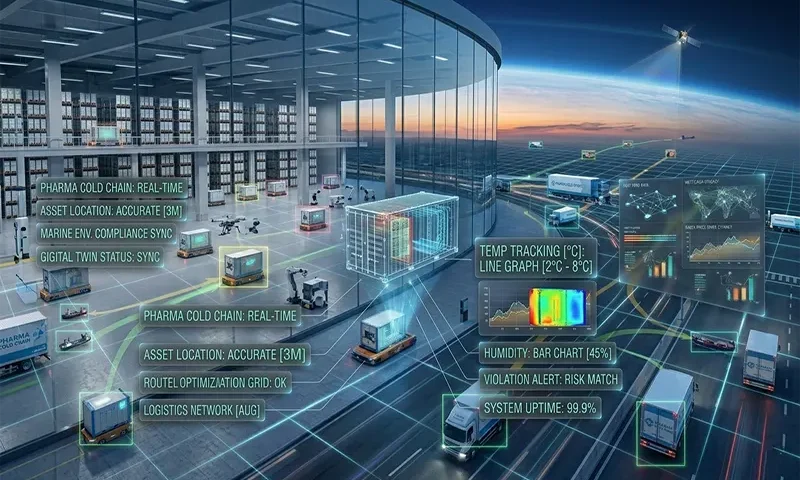
In 2026, the pharmaceutical industry has reached a “zero-tolerance” threshold for logistics failures. The rise of personalized medicine, mRNA platforms, and complex biologics requires a level of environmental control that traditional data loggers simply cannot provide. The solution is the Digital Twin—a real-time, virtual replica of the physical shipment. By fusing IoT sensor data with predictive simulation models, pharmaceutical companies are moving from reactive visibility to prescriptive control, ensuring that life-saving therapies reach patients with their molecular integrity fully intact.
From Visibility to Predictability
The global pharmaceutical cold chain is no longer just about “keeping things cold.” With the arrival of Cell and Gene Therapies (CGTs) that require cryogenic temperatures of $-150\text{°C}$ and vaccines that must remain within a strict $2\text{°C}$ to $8\text{°C}$ window, the margin for error is non-existent.
In this high-stakes environment, a Digital Twin acts as a bidirectional bridge. It is not merely a “dot on a map” but a virtual model that lives in the cloud, mirroring the physical shipment’s temperature, location, and internal pressure. While traditional tracking tells you that a shipment is too warm, a Digital Twin tells you that it will be too warm in four hours based on current flight delays and ambient weather, allowing for intervention before the “Stability Budget” is exhausted.
The Technological Foundation
The efficacy of a Digital Twin depends on the quality and continuity of its data stream.
- IoT Sensor Fusion: Modern “Smart Shippers” utilize NIST-traceable sensors that monitor more than just heat. They track Shock/Vibration (critical for delicate proteins), Light Exposure (detecting unauthorized box openings), and Pressure (monitoring aircraft cargo hold integrity).
- Ubiquitous Connectivity: In 2026, the “dead zones” of the ocean and the sky have been eliminated. By combining 5G terrestrial networks with LEO (Low Earth Orbit) satellite constellations, shipments maintain a persistent connection even in the middle of the Atlantic or at $35,000$ feet.
- Prescriptive Commands: The Digital Twin can send data back to the physical asset. For example, if the twin predicts a delay, it can command the shipper’s internal cooling system to shift into an “Eco-Mode” to preserve battery life and phase-change material (PCM) duration.
Core Digital Twin Capabilities
The true value of the twin lies in its ability to simulate the future:
1. Simulated Stress Testing (What-If Scenarios)
If a shipment is diverted to a transit hub in Dubai where the ambient temperature is $45\text{°C}$, the Digital Twin runs a simulation: “Based on the current remaining mass of dry ice and the external heat flux, how many hours do we have before the internal temperature exceeds $-60\text{°C}$?” #### 2. Dynamic Stability Budgeting
Every drug has a “Stability Budget”—a cumulative amount of time it can spend outside its ideal temperature range before degrading. The Digital Twin tracks this budget in real-time. If a minor deviation occurs, the twin recalculates the Remaining Shelf Life (RSL), notifying the receiving hospital if the drug is still safe to use or must be quarantined.
Operationalizing the Data: Control Towers and Edge AI
To manage thousands of concurrent shipments, pharma giants use AI-Driven Control Towers.
Instead of humans watching thousands of green lights, Edge AI on the tracking devices filters out “noise.” The system only alerts the Control Tower when a “Critical Variance” is predicted. This prevents “alarm fatigue” and ensures that logistics teams only intervene when the Digital Twin identifies a high-probability risk of spoilage.
Regulatory and Financial Impact
Pharma is the world’s most regulated industry. Digital Twins must comply with FDA 21 CFR Part 11 and EU Annex 11.
- Validation: Systems must be validated through IQ/OQ/PQ (Installation, Operational, and Performance Qualification) to ensure the virtual model accurately reflects physical reality.
- Smart Contracts: In 2026, Digital Twins are linked to Blockchain-based insurance. If the Twin records a temperature excursion that exceeds the drug’s validated stability profile, an insurance claim is automatically filed and paid out via smart contract, bypassing months of manual auditing.
Case Study Scenario: The Ultra-Low Temp Journey
Consider a batch of personalized oncology therapy moving from a lab in Switzerland to a clinic in rural Southeast Asia:
- Departure: The shipper is activated; the Digital Twin is initialized with the drug’s specific thermal profile.
- The Delay: A tropical storm grounds the connecting flight in Singapore.
- The Simulation: The Twin identifies the delay and calculates that the $-70\text{°C}$ environment will hold for another 72 hours.
- The Intervention: The Twin suggests an alternative flight path through a cooler hub. Logistics teams execute the change.
- The Arrival: The drug arrives at $99.9\%$ stability. The Twin provides a “Digital Birth Certificate” proving the chain of custody was never broken.
The Autonomous Cold Chain
As we look toward 2030, the human element in logistics will continue to recede. We are moving toward a “Self-Healing Supply Chain,” where Digital Twins will not just suggest interventions but will autonomously re-route shipments, negotiate with carrier AI, and manage “Last-Mile” delivery drones. In this future, the Digital Twin is the ultimate guardian of patient safety, ensuring that the miracle of modern medicine is never undone by the chaos of global logistics.
Functional Layers of the Pharma Digital Twin
| Layer | Components | Primary Function |
| Physical Layer | IoT Sensors, PCM Shippers, LN2 Tanks | Data collection and thermal protection. |
| Communication Layer | 5G, LEO Satellites (Starlink), Bluetooth | Real-time transmission of telemetry. |
| Edge Intelligence | On-device ML models | Threshold filtering and local alerts. |
| Digital Twin Layer | Virtual Simulation / Physics Models | “What-if” modeling and stability prediction. |
| Business Layer | Control Towers, ERP, Blockchain | Decision making, insurance, and compliance. |

