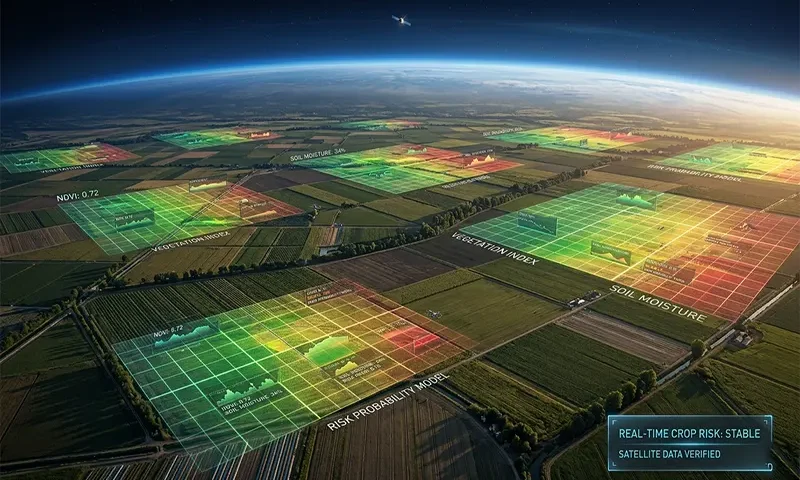
Real-Time Satellite Crop Health Analysis for Climate Risk Insurance

The global agricultural insurance market is undergoing a structural transformation. As climate volatility renders traditional indemnity-based models economically unviable, “top-down” satellite monitoring has emerged as the foundational technology for the next generation of parametric insurance. By leveraging high-revisit orbital constellations and advanced vegetation indices, insurers can now offer automated, low-latency coverage that protects food security and financial stability in an increasingly unpredictable climate.

The Vulnerability of Global Food Systems

The traditional agricultural insurance model is at a breaking point. Under the “Indemnity-Based” system, a farmer suffers a loss, files a claim, and waits for a human loss adjuster to physically visit the field to verify the damage. In a year of widespread drought or catastrophic flooding, this process is agonizingly slow, prone to human error, and prohibitively expensive for insurers to administer.

Furthermore, as climate-induced crop failures become more frequent and severe, the administrative overhead of manual adjustment is making … Read the rest


Key Takeaways and Summaries of Artificial Intelligence: A Modern Approach (4th Edition)

Since its initial publication, Stuart Russell and Peter Norvig’s Artificial Intelligence: A Modern Approach (AIMA) has served as the definitive “bible” of the field. The 4th Edition marks a pivotal shift, moving from the classical, logic-heavy paradigms of the past toward a modern synthesis of deep learning, probabilistic reasoning, and human-centered AI safety. This summary explores the core philosophy of the rational agent and the technical evolution of the text.

The Definitive Guide to Rationality

The central theme of AIMA remains the concept of the Rational Agent. Unlike earlier definitions of AI that focused on “thinking like humans” or “acting like humans” (the Turing Test approach), Russell and Norvig define AI as the study of agents that receive percepts from the environment and perform actions that maximize their expected utility.

The 4th Edition is a significant departure from its predecessor. While previous versions treated “Connectionist AI” (Neural Networks) as … Read the rest

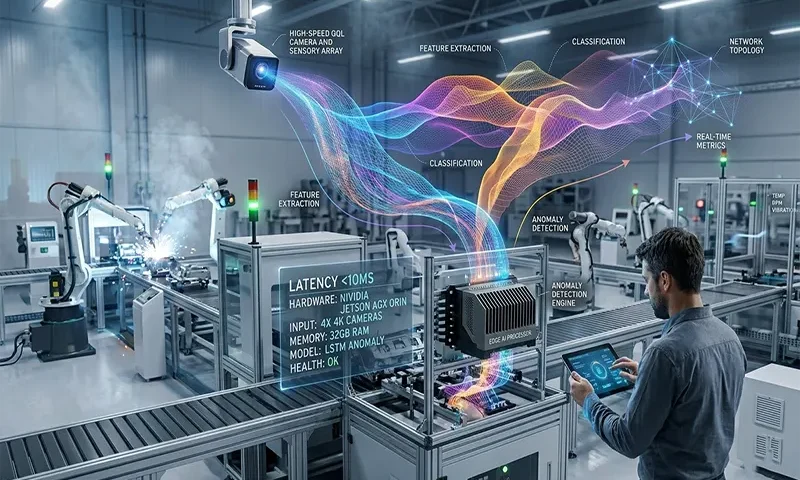
Edge AI Hardware Requirements for Real-Time Anomaly Detection in Manufacturing

In the 2026 industrial landscape, the transition from “cloud-augmented” to “edge-autonomous” manufacturing is complete. Real-time anomaly detection—the ability to identify and respond to micro-deviations in production within milliseconds—now dictates the competitive edge. Achieving this requires a specialized hardware stack that balances raw throughput ($TOPS$) with extreme environmental ruggedization and ultra-low latency I/O.

The Physics of the Production Line

In modern high-speed manufacturing, “real-time” is no longer a marketing buzzword; it is a physical requirement defined by the speed of the assembly line. A beverage bottling plant operating at 1,200 units per minute allows for a window of less than $50ms$ to detect a structural flaw and trigger a pneumatic reject arm.

Cloud-based AI fails in this environment due to the Latent Jitter inherent in wide-area networks. Even with 5G integration, the round-trip time ($RTT$) for data transmission, combined with cloud inference variability, often exceeds the safety-critical thresholds. Consequently, anomaly detection … Read the rest

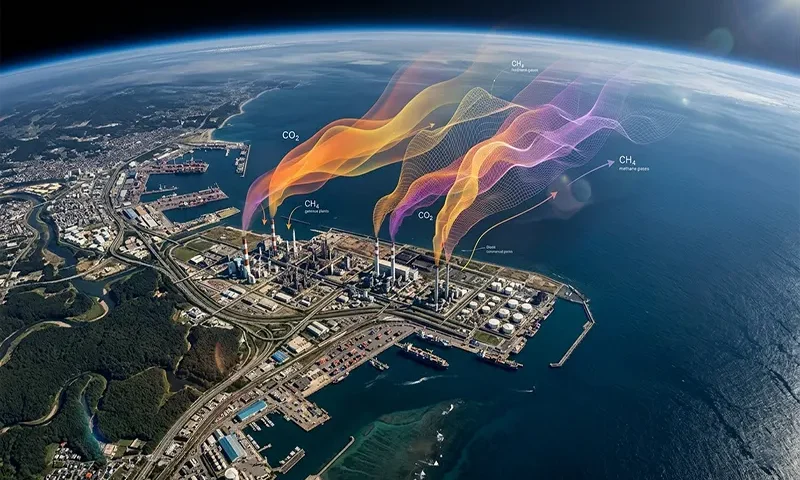
High-Resolution Satellite Monitoring for Corporate Greenhouse Gas Emissions

Executive Summary: As global regulatory frameworks tighten and stakeholder demand for transparency peaks, the reliance on self-reported, “bottom-up” emissions estimates is no longer sufficient. High-resolution satellite monitoring is emerging as the ultimate “truth engine” in ESG reporting. By transitioning from theoretical calculations to direct orbital observations, corporations can identify super-emitters in real-time, mitigate Scope 3 risks, and provide investors with the high-fidelity data required to prove genuine decarbonization.

The Trust Gap: From Estimation to Observation

For decades, corporate greenhouse gas (GHG) reporting has been an exercise in accounting rather than measurement. Companies typically calculate their carbon footprint using “emission factors”—multiplying activity data (like fuel consumed) by a theoretical average of emissions produced. While useful, this “bottom-up” approach is prone to significant error, often missing fugitive emissions or equipment malfunctions that can lead to massive, unreported leaks.

This has created a significant Trust Gap. Investors and regulators are increasingly skeptical … Read the rest