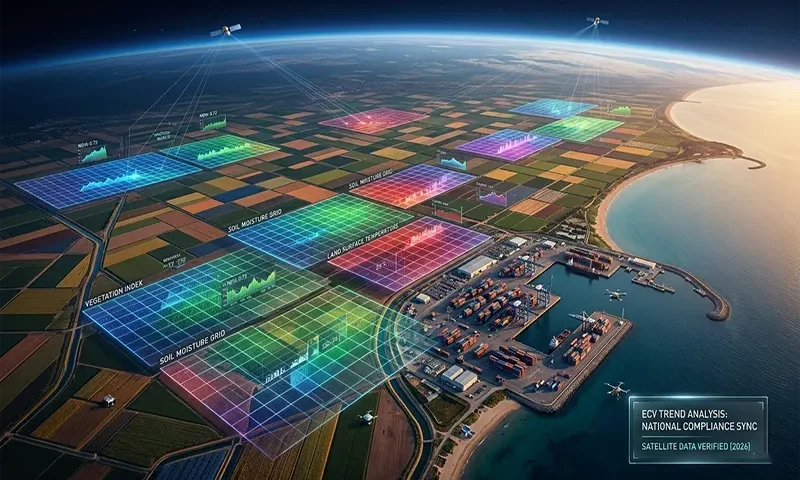

Satellite-Derived Essential Climate Variables (ECVs) for National Policy Reporting

As the international community enters the second Global Stocktake (GST) cycle in 2026, the reliance on self-reported national data is being supplemented by a “Top-Down” orbital audit. Essential Climate Variables (ECVs), defined by the Global Climate Observing System (GCOS), provide the objective, physical evidence required to verify Nationally Determined Contributions (NDCs). By transitioning from statistical estimates to satellite-verified observations, national governments can enhance the scientific defensibility of their climate inventories and ensure compliance with the Enhanced Transparency Framework (ETF) of the Paris Agreement.

The Transparency Imperative of 2026

The year 2026 marks a pivotal moment in global climate governance. Under the Paris Agreement’s Enhanced Transparency Framework, countries are now required to submit Biennial Transparency Reports (BTRs) that provide a clear, standardized account of their emissions and progress.

Essential Climate Variables (ECVs) are the critical metrics—spanning atmospheric, terrestrial, and oceanic domains—that characterize Earth’s climate. For national policy reporting, satellite-derived ECVs have … Read the rest

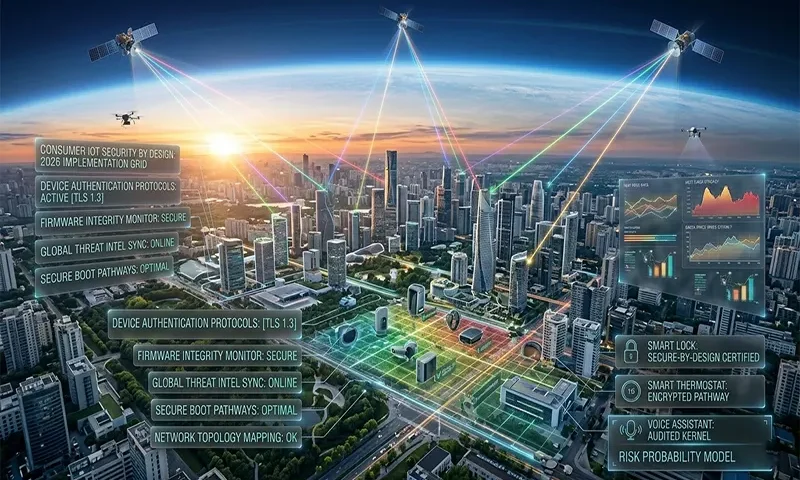
Implementing Security by Design for Consumer IoT Devices in 2026

In the hyper-connected landscape of 2026, the traditional “ship now, patch later” mentality has become a liability of catastrophic proportions. With billions of active nodes ranging from smart bio-wearables to autonomous home energy systems, the attack surface is too vast for reactive security. Security by Design has evolved from a best-practice recommendation to a fundamental architectural requirement. By integrating silicon-level roots of trust, post-quantum readiness, and localized edge intelligence, manufacturers are building a resilient ecosystem where security is not a feature, but an inherent property of the device.

The Shift from ‘Patching’ to ‘Architecture’

As we navigate 2026, the IoT ecosystem has scaled beyond human intervention. The sheer volume of data and device diversity means that discovering a vulnerability and issuing a manual patch is often too slow to prevent a localized breach from becoming a global botnet.

Security by Design is the practice of embedding security requirements into every … Read the rest

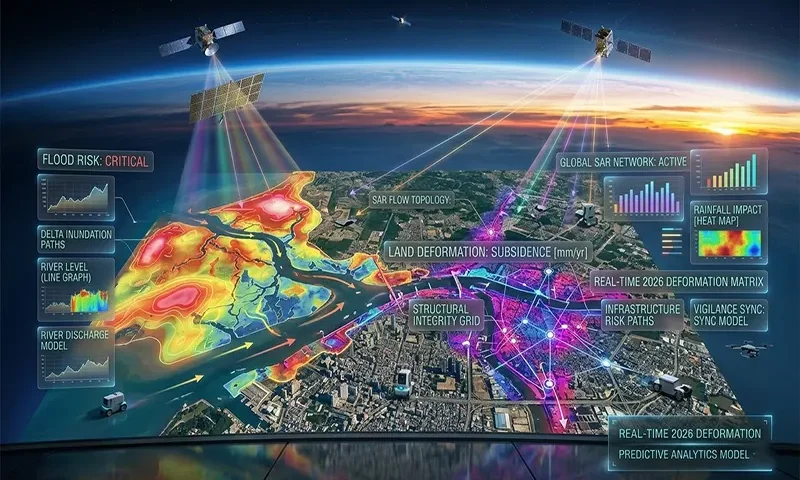
Synthetic Aperture Radar: Orbital Vigilance for Flood Risk and Land Deformation

In 2026, the global capacity for disaster resilience has been fundamentally transformed by the operational maturity of Synthetic Aperture Radar (SAR) constellations. Unlike traditional optical satellites that are blinded by the very storm clouds that cause disasters, SAR “sees” through atmospheric interference to provide high-resolution data in all weather conditions. By leveraging the unique dual-band capabilities of the NASA-ISRO SAR (NISAR) mission alongside the consistent archives of Sentinel-1, geospatial analysts can now map floods in real-time and detect millimeter-scale land deformations before they manifest as catastrophic failures.

The All-Weather Sentinel

The primary limitation of traditional Earth observation has always been its reliance on visible light. During a major hurricane or monsoon, optical sensors are rendered useless by cloud cover precisely when data is most needed. Synthetic Aperture Radar (SAR) overcomes this by being an active sensor; it emits its own microwave pulses and measures the “backscatter” that returns from … Read the rest