
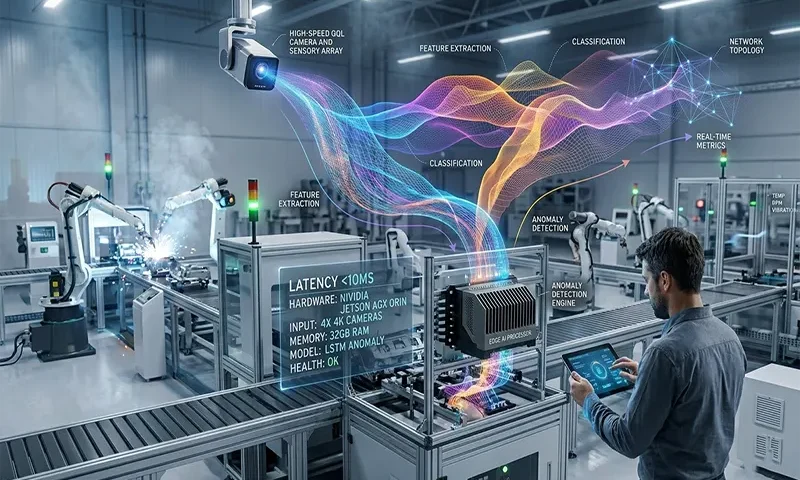
Edge AI Hardware Requirements for Real-Time Anomaly Detection in Manufacturing
In the 2026 industrial landscape, the transition from “cloud-augmented” to “edge-autonomous” manufacturing is complete. Real-time anomaly detection—the ability to identify and respond to micro-deviations in production within milliseconds—now dictates the competitive edge. Achieving this requires a specialized hardware stack that balances raw throughput ($TOPS$) with extreme environmental ruggedization and ultra-low latency I/O.
The Physics of the Production Line
In modern high-speed manufacturing, “real-time” is no longer a marketing buzzword; it is a physical requirement defined by the speed of the assembly line. A beverage bottling plant operating at 1,200 units per minute allows for a window of less than $50ms$ to detect a structural flaw and trigger a pneumatic reject arm.
Cloud-based AI fails in this environment due to the Latent Jitter inherent in wide-area networks. Even with 5G integration, the round-trip time ($RTT$) for data transmission, combined with cloud inference variability, often exceeds the safety-critical thresholds. Consequently, anomaly detection … Read the rest
