
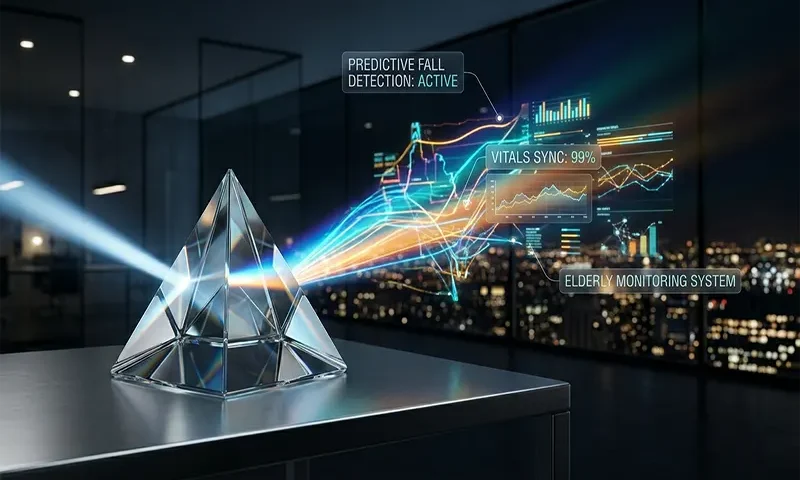
As the global population ages, the “fear of falling” has become a primary driver of reduced mobility and loss of independence among the elderly. Traditional medical alert buttons—while life-saving—are reactive by design. The 2026 health-tech landscape is shifting toward Predictive Wearables. By synthesizing high-frequency motion data with continuous vital sign monitoring, these devices can now identify the physiological “warning signs” of a fall days before it occurs, fundamentally redefining the concept of aging in place.
The Silent Crisis of Aging in Place
For the elderly, a fall is rarely just an accident; it is often the beginning of a rapid decline in quality of life. Statistically, one in three adults over the age of 65 falls each year, yet the psychological impact—the constant anxiety of being alone and incapacitated—often leads to “self-immobilization,” which ironically accelerates physical frailty.
Until recently, the industry standard was the “pendant” or “help button.” While effective for summoning aid after a disaster, these devices are useless if the wearer is unconscious or unable to reach the button. The new frontier is proactive monitoring: using AI-driven wearables that don’t just ask “Has a fall happened?” but rather “Is a fall likely to happen in the next 48 hours?”
The Sensor Suite: Beyond the Accelerometer
The transition from detection to prediction is made possible by a sophisticated array of sensors that go far beyond simple step-counting.
- 6-Axis IMUs (Inertial Measurement Units): Modern wearables utilize a combination of 3-axis accelerometers and 3-axis gyroscopes. These sensors monitor the user’s orientation and velocity in 3D space. While a fall involves a rapid acceleration toward the earth (approaching $9.8\ m/s^2$), predictive models look for “micro-stumbles” and postural sways that are invisible to the naked eye.
- PPG (Photoplethysmography): By using green and infrared light to measure blood flow at the wrist, PPG sensors provide continuous data on heart rate and blood oxygen saturation ($SpO_2$). These are critical for detecting “silent” issues like atrial fibrillation.
- ECG Patches and Hydration Sensors: High-end 2026 models now incorporate medical-grade ECG strips for detecting arrhythmias and bio-impedance sensors to monitor hydration levels—a major factor in elderly dizziness and subsequent falls.
Predictive Analytics: Spotting the Fall Before it Happens
The “intelligence” of these devices lies in their ability to correlate movement with physiology.
Gait Analysis and Stride Variability
AI models now perform continuous Gait Analysis. By measuring the consistency of stride length and the “swing phase” of a walk, the wearable can detect increased variability. If a user’s gait becomes significantly more asymmetrical or “shuffling” over a 24-hour period, it acts as a leading indicator of neuromuscular fatigue or neurological shifts, flagging a high fall-risk alert to caregivers.
Vitals Correlation and Syncope Prediction
Many falls are preceded by a physiological event. For example, Orthostatic Hypotension—a sudden drop in blood pressure when standing up—is a leading cause of fainting (syncope) in the elderly. By monitoring Heart Rate Variability ($HRV$) and $SpO_2$ in real-time, the device can detect the autonomic nervous system’s struggle to maintain blood pressure, vibrating the wearer’s wrist with a “Sit Down Now” alert before they lose consciousness.
The Role of Edge AI and Privacy
In 2026, the paradigm has shifted toward Edge AI—processing the data directly on the wearable rather than sending every heartbeat to the cloud.
- Latency: In a true fall event, every millisecond counts. On-device processing ensures that an emergency alert is triggered even if the home Wi-Fi is down.
- Dignity of Data: One of the greatest barriers to adoption is the feeling of being “watched.” Edge AI allows for “privacy by design,” where the raw data (like the specific movements in a bathroom) is never uploaded; only the high-level “Insights” and “Alerts” are shared with the care circle.
Connectivity and the Care Circle
Predictive wearables are becoming the central node in a Smart Home Ecosystem. When a high-risk state or an actual fall is detected:
- Telehealth Integration: A virtual nurse or family member is immediately notified via a 5G-enabled dashboard.
- Ambient Assistance: The wearable can communicate with the home’s smart lighting, turning all lights to 100% brightness to assist the fallen individual or the responding paramedics.
- Smart Access: In the event of a confirmed fall, the wearable can send a digital “key” to emergency services to unlock the front door, preventing the need for a forced entry.
Barriers to Adoption: The Human Factor
Despite the technical brilliance, two major hurdles remain:
- Wearable Fatigue: Elderly users often find bulky watches uncomfortable or difficult to charge. The industry is responding with “set it and forget it” designs, including jewelry-like rings and adhesive patches that last for 7–10 days on a single charge.
- The False Positive Challenge: AI must distinguish between a user falling and a user flopping onto a soft sofa. High-fidelity $9.8\ m/s^2$ detection combined with barometric pressure sensors (to detect a change in altitude/height) has significantly reduced false alarms in the latest generation of devices.
The Future of Aging with Dignity
By the end of this decade, the “fear of falling” will no longer be a mandate for nursing home transition. Predictive wearables represent a shift from “sick care” to “well care,” providing a digital safety net that is invisible yet omnipresent. As these devices become smaller, smarter, and more empathetic, they offer the ultimate gift to the aging population: the ability to live independently, with the confidence that their health is being guarded by the very technology they wear on their wrist.
Comparison: Traditional vs. Modern AI Systems
| Feature | Traditional Medical Alert | Modern AI Predictive Wearable |
| Response Type | Reactive (User must press button) | Proactive (Automatic detection & prediction) |
| Data Tracked | None (Standby mode only) | Continuous $HRV$, $SpO_2$, & Gait |
| Fall Detection | Impact-based only | Behavioral & Physiological precursors |
| Privacy | Low (Often requires base station/mic) | High (Edge AI / Localized processing) |
| Connectivity | Landline / Cellular Base | 5G, Bluetooth, & Smart Home Mesh |
| Primary Goal | Summoning Help | Preventing the Incident |

