
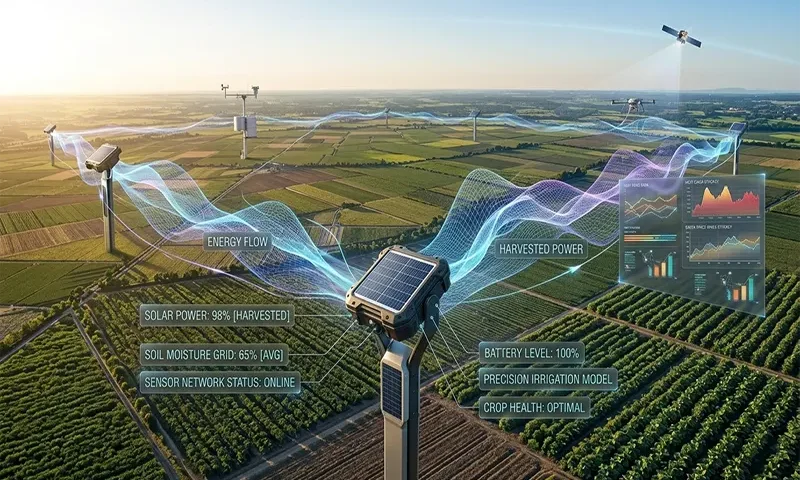
In the quest for “Sustainable Intensification,” the primary bottleneck has shifted from data processing to data persistence. As of 2026, the deployment of thousands of sensors across vast, off-grid agricultural landscapes has made traditional battery maintenance an operational impossibility. Solar-powered energy harvesting—specifically the transition toward perpetual, maintenance-free sensor nodes—has emerged as the definitive solution. By integrating high-efficiency photovoltaic transducers with advanced power management and edge computing, modern farms are establishing a self-sustaining digital nervous system.
The Power Paradox in Remote Farming
The promise of Smart Agriculture—precise irrigation, targeted fertilization, and early pest detection—relies on high-density sensor networks. However, these networks face a “Power Paradox”: the more data we require to be sustainable, the more batteries we consume, creating a new cycle of chemical waste and logistical labor.
In 2026, the “battery swap” model is dead. Manually replacing cells in a 5,000-acre cornfield is not only cost-prohibitive but environmentally counter-productive. To achieve a truly “Green” digital transformation, sensor nodes must harvest their own energy from the environment. Solar energy remains the most reliable and energy-dense ambient source available for outdoor agricultural deployment.
The Architecture of a Solar-Harvesting Node
A perpetual sensor node is more than just a sensor wired to a solar panel; it is a finely tuned energy-balancing system.
1. Photovoltaic (PV) Transducers
Modern nodes utilize Monocrystalline Silicon or emerging Perovskite thin-films. Perovskite cells are gaining traction in 2026 due to their ability to harvest energy across a broader spectrum of light, maintaining higher efficiency in the diffused “shady” light found under orchard or vineyard canopies. The efficiency of these cells ($\eta$) is the ratio of the electrical power output ($P_{out}$) to the solar power input ($P_{in}$):
$$\eta = \frac{P_{out}}{P_{in}}$$
2. Power Management Integrated Circuits (PMICs)
The heart of the system is the PMIC featuring Maximum Power Point Tracking (MPPT). Because solar intensity fluctuates with cloud cover and sun angle, MPPT dynamically adjusts the electrical load to ensure the PV cell is always operating at its peak efficiency. Modern PMICs can now begin cold-starting from as little as $10\ \mu W$ of harvested power.
3. Energy Storage: The Shift to Supercapacitors
While Lithium-ion (Li-ion) batteries have been the standard, 2026 has seen a decisive shift toward Supercapacitors or Hybrid Lithium-Capacitors. Traditional batteries degrade over 2–3 years and fail in extreme frost or heat. Supercapacitors offer:
- High Cycle Life: Over 500,000 charge cycles compared to 1,000 for Li-ion.
- Thermal Stability: Reliable operation from $-40\text{°C}$ to $85\text{°C}$, essential for year-round field exposure.
Sensor Modalities and Power Budgets
To survive on harvested energy, the “Power Budget” must be meticulously managed. Every micro-ampere ($\mu A$) counts.
- The Duty Cycle Strategy: A node does not stay “on.” It spends 99% of its time in a deep-sleep state, consuming $<1\ \mu A$. It wakes up for milliseconds to take a soil moisture reading or check Nitrogen/Phosphorus/Potassium (NPK) levels, then transmits the data via LPWAN (LoRaWAN or NB-IoT).
- The Energy Cost of Communication: Wireless transmission is the most “expensive” task. By using LoRaWAN, a node can transmit data over several kilometers using only a few milliwatts ($mW$) of power, which is easily replenished by a few minutes of sunlight.
Advanced 2026 Trends: Hybrid Harvesting and Edge AI
The cutting edge of 2026 agricultural IoT involves “Hybridization”:
- Solar-Piezoelectric Hybrids: New enclosures utilize piezoelectric materials that generate electricity from the mechanical vibration of raindrops or wind. This provides a “nighttime” or “storm-day” energy backup, ensuring near 100% uptime regardless of solar availability.
- Edge AI Inference: Rather than sending raw, high-bandwidth data (which drains energy), modern nodes perform Edge AI locally. For example, an acoustic sensor can “listen” for pest vibrations and only transmit a “Pest Detected” alert, reducing radio uptime and saving significant energy.
Impact on Sustainable Intensification
Perpetual sensors allow for “Hyper-Local” management:
- Water Conservation: Real-time soil moisture maps allow irrigation systems to provide the exact amount of water needed, preventing aquifer depletion.
- Reduced Runoff: By monitoring NPK levels perpetually, farmers can apply fertilizers only where the soil is deficient, preventing nitrogen runoff into local waterways.
- Scope 3 Reporting: These sensors provide the “Primary Data” required for corporate carbon tracking, proving the carbon sequestration capabilities of regenerative farming practices.
Operational Challenges and Mitigation
Field life for an energy harvester is brutal. Two primary challenges remain:
- Bio-fouling and Dust: Dust, bird droppings, and pollen can reduce PV efficiency by 30% or more. 2026 designs utilize Super-hydrophobic (self-cleaning) coatings that allow morning dew to roll off the panel, carrying dust with it.
- Ruggedization: Nodes must meet IP68 standards to survive submersion during floods and the high-pressure spray of cleaning equipment.
Toward the ‘Perpetual’ Farm
As we look toward the end of the decade, the “Perpetual Farm” is becoming a reality. Solar-powered energy harvesting has transformed the sensor from a high-maintenance “device” into a “deploy-and-forget” infrastructure component, much like a fence post or an irrigation pipe. By removing the battery bottleneck, we have cleared the path for a truly autonomous, self-powering digital nervous system that ensures food security while honoring the ecological limits of our planet.
Technical Comparison: Powering the Smart Farm
| Feature | Standard Battery Nodes | Solar-Harvesting Nodes (2026) |
| Operational Lifespan | 1–3 years (until battery death) | 10–15 years (limited by hardware) |
| Maintenance | High (Labor-intensive swaps) | Zero (Self-sustaining) |
| Energy Storage | Chemical (Li-ion/Alkaline) | Supercapacitors / Hybrids |
| Environmental Impact | High (Chemical waste) | Low (Renewable / Reusable) |
| Deployment Scale | Limited by logistics | Virtually unlimited |
| Reliability | Drops as battery nears end-of-life | Constant (mediated by storage) |
| Operating Temp | Limited ($0\text{°C}$ to $40\text{°C}$) | Extreme ($-40\text{°C}$ to $85\text{°C}$) |

