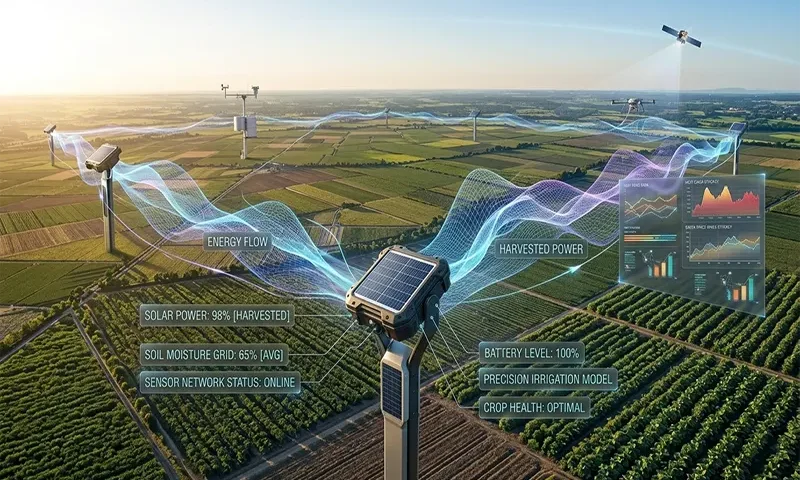
Solar-Powered Energy Harvesting Sensors for Smart Agriculture Monitoring

In the quest for “Sustainable Intensification,” the primary bottleneck has shifted from data processing to data persistence. As of 2026, the deployment of thousands of sensors across vast, off-grid agricultural landscapes has made traditional battery maintenance an operational impossibility. Solar-powered energy harvesting—specifically the transition toward perpetual, maintenance-free sensor nodes—has emerged as the definitive solution. By integrating high-efficiency photovoltaic transducers with advanced power management and edge computing, modern farms are establishing a self-sustaining digital nervous system.

The Power Paradox in Remote Farming

The promise of Smart Agriculture—precise irrigation, targeted fertilization, and early pest detection—relies on high-density sensor networks. However, these networks face a “Power Paradox”: the more data we require to be sustainable, the more batteries we consume, creating a new cycle of chemical waste and logistical labor.

In 2026, the “battery swap” model is dead. Manually replacing cells in a 5,000-acre cornfield is not only cost-prohibitive but environmentally counter-productive. To … Read the rest


Applying the Rational Agent Approach to Modern Autonomous AI Agents in 2026

In the history of artificial intelligence, 2026 will be remembered as the year of the “Agentic Turn.” We have moved beyond the era of static Large Language Models (LLMs) that merely predict text, into an era of autonomous entities that plan, reason, and execute. At the heart of this transition lies the Rational Agent framework—a concept pioneered by Stuart Russell and Peter Norvig. By applying the rigorous standards of utility and rationality to modern agentic workflows, we can build systems that are not only powerful but also provably aligned with human intentions.

The Resurrection of the Agent

In the seminal text Artificial Intelligence: A Modern Approach (AIMA), a Rational Agent is defined as an entity that perceives its environment and acts so as to maximize its expected utility. For decades, this was a theoretical ideal. However, in 2026, the rise of “Agentic AI”—systems capable of using tools, navigating digital … Read the rest

Predictive Wearable Health Monitors: The New Frontier in Elderly Fall Detection and Vitals

As the global population ages, the “fear of falling” has become a primary driver of reduced mobility and loss of independence among the elderly. Traditional medical alert buttons—while life-saving—are reactive by design. The 2026 health-tech landscape is shifting toward Predictive Wearables. By synthesizing high-frequency motion data with continuous vital sign monitoring, these devices can now identify the physiological “warning signs” of a fall days before it occurs, fundamentally redefining the concept of aging in place.

The Silent Crisis of Aging in Place

For the elderly, a fall is rarely just an accident; it is often the beginning of a rapid decline in quality of life. Statistically, one in three adults over the age of 65 falls each year, yet the psychological impact—the constant anxiety of being alone and incapacitated—often leads to “self-immobilization,” which ironically accelerates physical frailty.

Until recently, the industry standard was the “pendant” or “help button.” While … Read the rest

Key Takeaways and Summaries of Artificial Intelligence: A Modern Approach (4th Edition)

Since its initial publication, Stuart Russell and Peter Norvig’s Artificial Intelligence: A Modern Approach (AIMA) has served as the definitive “bible” of the field. The 4th Edition marks a pivotal shift, moving from the classical, logic-heavy paradigms of the past toward a modern synthesis of deep learning, probabilistic reasoning, and human-centered AI safety. This summary explores the core philosophy of the rational agent and the technical evolution of the text.

The Definitive Guide to Rationality

The central theme of AIMA remains the concept of the Rational Agent. Unlike earlier definitions of AI that focused on “thinking like humans” or “acting like humans” (the Turing Test approach), Russell and Norvig define AI as the study of agents that receive percepts from the environment and perform actions that maximize their expected utility.

The 4th Edition is a significant departure from its predecessor. While previous versions treated “Connectionist AI” (Neural Networks) as … Read the rest

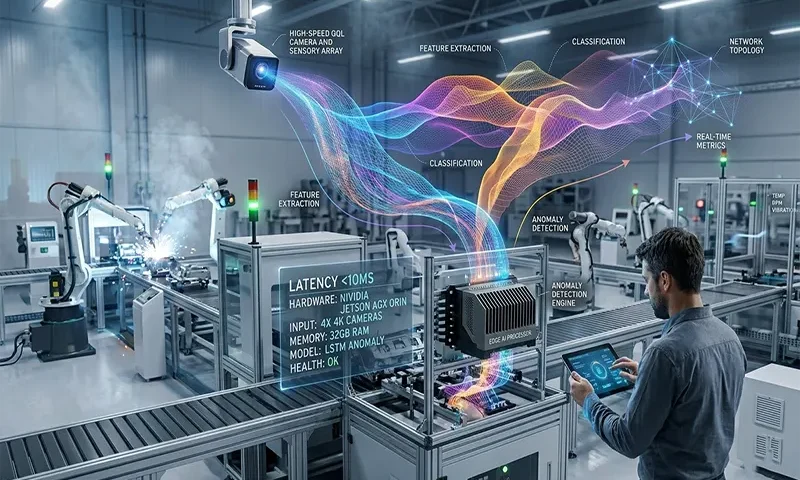
Edge AI Hardware Requirements for Real-Time Anomaly Detection in Manufacturing

In the 2026 industrial landscape, the transition from “cloud-augmented” to “edge-autonomous” manufacturing is complete. Real-time anomaly detection—the ability to identify and respond to micro-deviations in production within milliseconds—now dictates the competitive edge. Achieving this requires a specialized hardware stack that balances raw throughput ($TOPS$) with extreme environmental ruggedization and ultra-low latency I/O.

The Physics of the Production Line

In modern high-speed manufacturing, “real-time” is no longer a marketing buzzword; it is a physical requirement defined by the speed of the assembly line. A beverage bottling plant operating at 1,200 units per minute allows for a window of less than $50ms$ to detect a structural flaw and trigger a pneumatic reject arm.

Cloud-based AI fails in this environment due to the Latent Jitter inherent in wide-area networks. Even with 5G integration, the round-trip time ($RTT$) for data transmission, combined with cloud inference variability, often exceeds the safety-critical thresholds. Consequently, anomaly detection … Read the rest